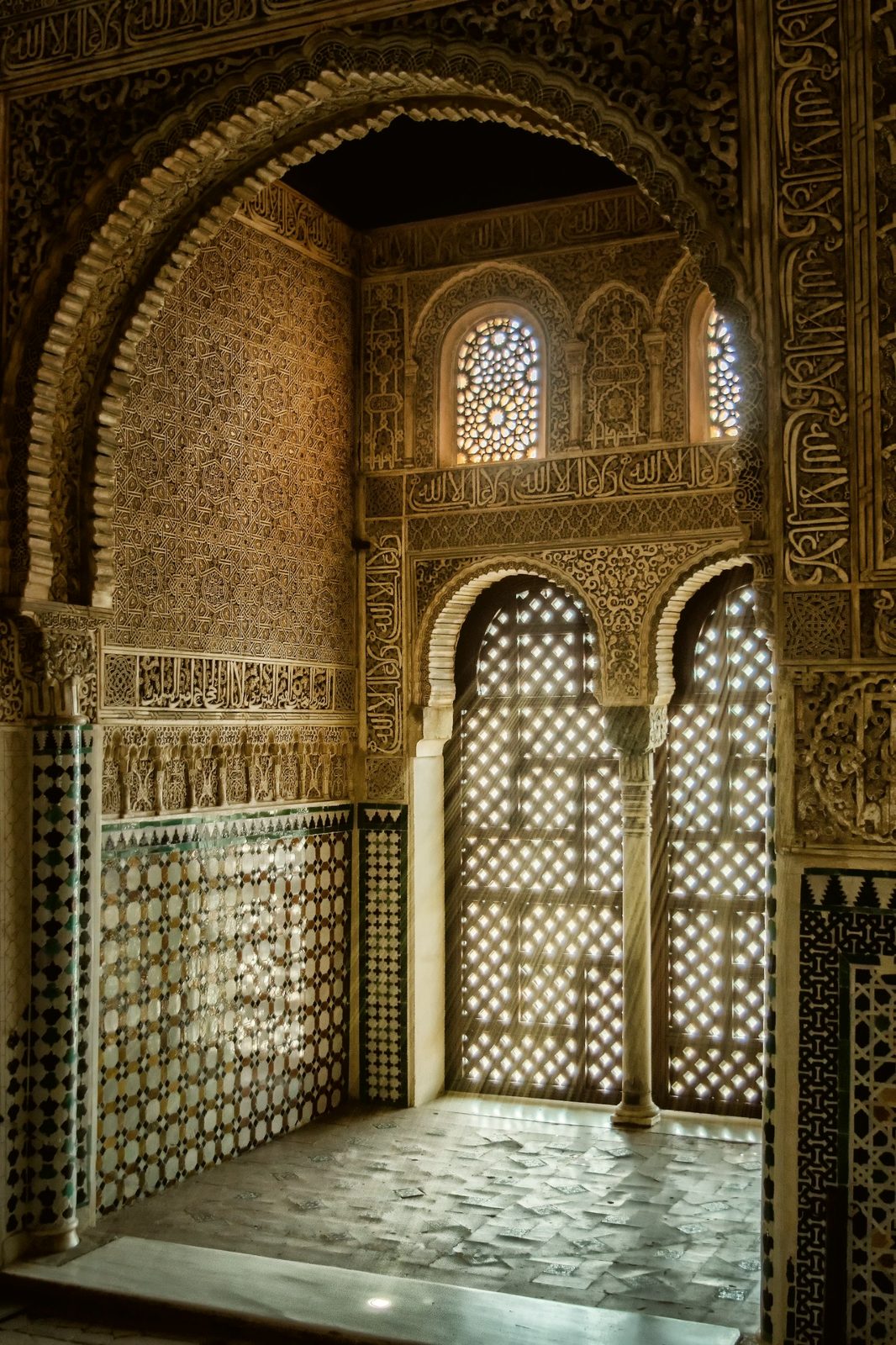
Stand beneath the dome of the Hall of the Two Sisters and it appears to dissolve. Thousands of small plaster cells, the muqarnas, step upward in a pattern that never quite repeats to the eye. Most accounts put the count at around five thousand. Poetry runs along the walls, and the building speaks it in the first person. It helps to arrive knowing what it is saying.
The hall was built for Muhammad V, the Nasrid sultan responsible for much of what visitors now come to see, as part of the Palace of the Lions in the late fourteenth century. Its name comes from nothing more romantic than two large slabs of white marble set into the floor, either side of a small fountain whose water runs out along a channel to the Court of the Lions.
Muqarnas solve an awkward problem: how to rest a round dome on a square room. Small concave cells are stacked in tiers, each projecting a little beyond the one below, until the corners are filled and the ring of the dome is closed. Seen from below, the structure disappears. What remains is light, broken into thousands of facets, shifting as the sun moves past the windows.
The ceiling grows outward from a star at its crown. Every cell belongs to a small family of shapes, fitted together by rules a Nasrid craftsman learned at the bench rather than from a book. That is why it rewards patience. Find the central star, then follow a single ring of cells down towards the walls, and you will see the same few forms turning, splitting and joining again.
Then lower your eyes to the band of calligraphy above the tiled dado. These are verses by Ibn Zamrak, poet and vizier to Muhammad V, and in them the hall describes itself. It calls itself a garden adorned with beauty and compares its dome to the heavens. The room is not decorated with a poem. It is reciting one.
Go early or late, when light through the high windows is low enough to rake across the cells. Stand in the centre first, then at each corner, and give it a quarter of an hour. The Alhambra is busy for most of the year and the room fills quickly, but the ceiling has a way of making a crowd go quiet.
Granada lies outside our three collectives, but it belongs to the same Moorish tradition as the madrasas of Fes and Marrakech. If you would like to see it, tell us when you plan your journey.